
News

NEWS: Pass or Fail, the Redistricting Amendment Means an Extra Election

February 20, 2026

For local registrars that means additional work they didn’t expect, and costs that weren’t budgeted for. Voters are more likely to be confused. And legal challenges are rising.

Feb 19, 2026

By Martin Davis
EDITOR-IN-CHIEF
Email Martin

This week, Del. Dan Helmer (D — HD 10) announced that he would be running for Congress in Virginia’s 7th District. Democratic Rep. Euguene Vindman, who currently holds the 7th District seat, is now planning to run in the 1st District.

The musical-chairs-type moves are the result of the General Assembly’s mid-cycle redistricting in order to gerrymander Virginia’s congressional districts and ensure more Democrats go to Washington this November.

Redistrictings are typically done following each decennial census, which next occurs in 2030. This year’s move is meant to balance the books because states like Texas are gerrymandering their districts to keep Republicans in control of Congress — a challenging proposition given that President Donald Trump’s poll numbers continue to fall and independent voters are jumping the Republican ship.

Share

All of these moves hinge, however, on Virginians voting on a constitutional amendment on April 21 to allow the General Assembly to redraw the lines. And then the State Supreme Court’s upholding the decision.

Neither is a foregone conclusion.

A recent poll by the Wason Center at Christopher Newport University shows Virginians favor mid-cycle redistricting 51% – 49%. That thin 2-point advantage is well within the poll’s margin of error of +/-4.4%, however, at the 95% level of confidence. In other words — the poll shows the special election a toss-up.

Pass or fail, the amendment is upsetting the primary voting schedule for congressional elections in Virginia and raising several legal challenges.

The result? Headaches for local registrars, challenges for candidates, and local legal tangles.

Shifting the Dates, Opening Legal Challenges
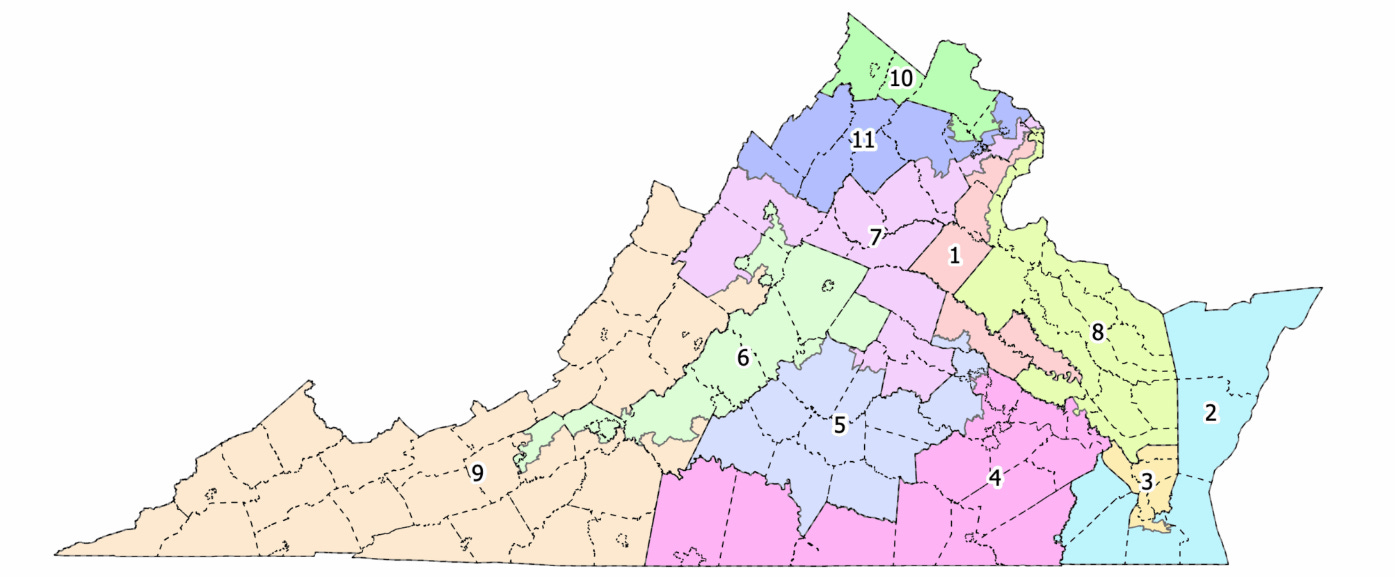
Virginia Democrats’ proposed 10-D, 1-R congressional district map. (Photo courtesy Virginia Legislative Information System)

Holding the special election on April 21 requires moving the previously established dates for candidates’ filing documents as well as for the primaries.

In order to qualify for the primary ballots, individuals looking to run for a seat in the House of Representatives were originally required to file their paperwork no later than on April 2. That day, however, is 19 days prior to the special election. Consequently, the filing dates have been moved to May 25.

The primary date will then be moved from June 16 to August 4, according to House Bill 29, which funds the special election.

Whether the constitutional amendment to allow mid-cycle redistricting passes, these dates will hold.

The April 21 date comes with another wrinkle, however. To accommodate early voting requirements, the polls will open to voters on March 6.

But on Thursday evening, the Spotsylvania Board of Supervisors challenged that date, passing a resolution that argues early voting could not occur before April 16 — just five days prior to election day.

The reason rests in how the Board reads Article XII, Section 1 of the Constitution of Virginia.

It states that no proposed amendment to the Constitution “shall be submitted to the voters sooner than 90 days after final passage by the General Assembly.

The bill that triggered the special election was passed on January 16 of this year. Ninety days from that date, then, would be April 16.

In its resolution that passed 6-0 with Supervisor Deborah Frazier abstaining, the Board said that “a legitimate constitutional question exists as to whether authorizing legally binding ballots to be cast prior to April 16, 2026” is to be allowed.

Responding to the decision, Nicole Cole (D – HD66) who represents parts of Spotsylvania, told the Advance via phone that “[t]he State has put forward the special election, and HB 29 funds it. So the actions of jurisdictions not in support of this special election are performative. We want to give the voters in Virginia a change to level the playing field for them to have a voice in federal government.”

Local Election Leaders Face Challenges

Assuming the amendment passes, dates won’t be the only issue. Local registrars face a number of challenges.

One of the first is adding yet another election to the year’s election docket. There will be potentially four elections this year:

  • The special election to vote on mid-cycle redistricting
  • The June 16 Republican primary, if necessary
  • The August 4 congressional primaries
  • The November general election

“It’s adding a level of complexity to the job I didn’t think I’d see in 2026,” Jessica Atkinson, director of elections for Fredericksburg, told the Advance.

Cost is one concern. “The average election costs between $30,000 and $50,000,” Atkinson said. “That’s extra money” she hasn’t budgeted for. The state is allocating $5 million to offset the costs of holding the August primary, but Atkinson notes that at this point it’s not known how much of that money her locality — or any locality — will actually receive.

Beyond money, however, is the issue of officers of elections. “If we go to August,” Atkinson said, “I may have to find a whole new group of people to train.”

Some election officials have already told Atkinson that an August date would conflict with other plans. This means bringing in more individuals, training them, and getting them ready for election day.

The greatest challenge Atkinson see, however, is voter education.

For the April special election, Atkinson told the Advance that people need to understand they are “not voting on a map, but a referendum that allows the General Assembly to redraw the map.” Already she has had people ask to see a copy of the congressional map the General Assembly has put forward. She has to remind them that “you’re not voting on that. You’ve voting on the referendum.”

That matters because the map produced by the General Assembly is not set in stone. That would not happen unless the amendment is approved. In fact, the maps are currently being tinkered with. “Yesterday,” Atkinson said, “the 2nd and 3rd districts” were adjusted some.

Another challenge is that Fredericksburg is likely to move from the 7th District to the 1st, where it previously was situated. Atkinson said it took a great deal of work to educate voters when the city was moved from the 1st to the 7th. If the referendum is approved, she will again have to make sure that people understand they are in a different district.

“I just spent time telling people they’re in the 7th, not the 1st. Now I have to tell them they’re in the 1st.”

Things are no less complicated in Stafford County.

For Anna Hash, director of elections in Stafford, three concerns are front-of-mind.

“The biggest concern for me,” she said, “is if any of our current precincts are going to be split. If they are, we will have to create additional precincts.”

Like Atkinson, she is also concerned about voter education. “There might be some confusion with the public if [the precincts are] split,” she said, “especially because the vast majority will [likely] be in one district, and just a sliver in the other.”

She also shares Atkinson concern that voters understand the April special election is voting on allowing the General Assembly to redistrict, and not on the map itself.

For Atkinson, the real concern may be simple “voter exhaustion.” “It’s a lot,” she said, to ask voters to vote as many as four times in one year.

Candidates and Two Campaigns

For candidates seeking office, delayed dates for the primary don’t mean that they can take their foot off of the campaign accelerator.

For Republican Doug Ollivant, who lives in Culpeper and will run in the 7th district whether the voters approve mid-cycle redistricting or not, said that he is forced to run his campaign in two geographic regions: the current 7th District, and the proposed new 7th that extends north to Alexandria, west to the West Virginia line, and south to Hanover.

“I have to hedge my bets,” Ollivant told the Advance. “So I have to talk to Fairfax, Louisa, and Rockingham. And that’s the position the legislature has put us in. We have to run two campaigns.”

State Sen. Tara Durant potentially faces the same challenge. She will likely have to run in the 1st Congressional District under the new map, which extends north to Alexandria and south toward Hanover, while also preparing for the possibility that if the amendment fails she will be competing in the current 7th, which tracks north only as far as southern Prince William, west into King George and Caroline, and west toward Greene County.

This story was updated on February 20 at 11:30 a.m. to correct the spelling of Jessica Atkinson’s name. We regret the error.

Doug Ollivant on NewsNation

November 27, 2025

Doug Ollivant on NewsNation

November 26, 2025

Doug Ollivant: ‘I Woke Up and Eugene Vindman Was My Congressman — Unacceptable’

November 13, 2025

Potomac Local News

By Uriah Kiser

Doug Ollivant, a retired U.S. Army officer and former National Security Council director, has announced his campaign for Virginia’s 7th Congressional District — a politically competitive seat stretching from eastern Prince William County through Stafford, Spotsylvania, Fredericksburg, and west to Culpeper, Greene, and a small slice of Albemarle County.

Ollivant, a Republican, appeared on Potomac Local News to discuss his decision to enter the race and his strategy for reaching voters in a district that has leaned Democratic in recent cycles.

“I woke up one morning and Eugene Vindman was my congressman, and I just found that utterly unacceptable,” Ollivant said. “I’m running to bring common sense, conservative, national security experience to the 7th District.”

A veteran of the wars in Iraq and Afghanistan, Ollivant served on the National Security Council under Presidents George W. Bush and Barack Obama and later taught politics at the U.S. Military Academy at West Point. He now lives in Culpeper County with his family.

GOP Faces Uphill Battle After Recent Elections

Ollivant acknowledged that Republicans face “a tough slog uphill” following recent statewide losses but said the results were not hopeless.

“We had a perfect storm for Virginia Republicans,” he said. “A government shutdown, concerns over SNAP benefits, and a candidate who didn’t connect with voters all worked against us. But those conditions won’t repeat in 2026.”

He emphasized the need for Republicans to engage younger voters, including those energized by conservative student movements such as Turning Point USA, as well as growing immigrant populations across the district.

“We need to be speaking to the younger generation and new citizens from Central and South America, Iraq, Afghanistan, and India,” Ollivant said. “It’s an indictment of us that we haven’t found a way to talk to them effectively.”

A Crowded Field Forms in VA-07

Ollivant joins a growing field of Republicans seeking to unseat Democrat Eugene Vindman, who first won the seat after redistricting in 2021. State Sen. Tara Durant (R–Fredericksburg) has also announced her candidacy.

Ollivant said he plans to focus on economic issues, national security, and government accountability — key concerns he believes can unite conservative and independent voters.

“We need to diagnose what went wrong in this past election and move beyond our base,” he said. “Republicans can’t win if we only talk to ourselves.”

About the District

Virginia’s 7th District was redrawn in 2021 by court order after an independent redistricting commission failed to reach an agreement. The district includes rapidly growing suburban areas and historically conservative rural communities, making it one of the state’s most competitive congressional seats.

Ollivant’s campaign website is dougforvirginia.com.

Doug Ollivant: Why I’m Running for Congress in Virginia’s 7th

November 12, 2025

Potomac Local News

Republican candidate Doug Ollivant joins Potomac Local News to discuss his campaign for Virginia’s 7th Congressional District (VA-07) — covering Eastern Prince William, Stafford, Spotsylvania, Fredericksburg, Culpeper, Greene, and a small portion of Albemarle County. Ollivant, a retired Army officer and former National Security Council director, shares his outlook on GOP strategy after recent elections, his thoughts on Donald Trump’s influence in Virginia, and his plan to connect with younger voters and shifting suburban demographics.

‘Hard, But Not Hopeless’: Olivant Calls for GOP Reset After Election Rout

November 5, 2025

Potomac Local News

By Uriah Kiser

“Tuesday night’s election was a bloodbath for Virginia Republicans,” Doug Olivant wrote on X after the party’s sweeping statewide losses. “The party lost all three of the top state offices—Governor, Lieutenant Governor, and Attorney General—as well as a still undetermined, but double-digit, number of Delegate seats.”

Olivant, a Republican candidate for Virginia’s 7th Congressional District—which includes Prince William, Stafford, Spotsylvania, King George, Caroline, and Fredericksburg—outlined a five-point critique of the GOP’s performance, citing leadership failures, fractured local committees, and weak voter outreach. “Richmond bet it all on an imposed candidate they selected—and lost big,” he wrote, calling for “wholescale reform and housecleaning.”

Despite the setback, Olivant said the party’s path forward depends on unity and authenticity. “The lesson from last night is not to despair,” he wrote. “The lesson from last night is to reform—at light speed.” The 7th District seat is currently held by Democrat Eugene Vindman.

Retired Army Lieutenant Colonel Doug Ollivant Announces Campaign for VA’s 7th Congressional District

September 16, 2025

Vows to Restore Fiscal Responsibility, Strengthen National Security, and Protect Virginia Families

Culpeper County, VA — Retired U.S. Army Lieutenant Colonel Doug Ollivant, a combat veteran, national security expert, and business leader, officially announced his candidacy for the Republican nomination for the United States Congress in Virginia’s 7th Congressional district today. A husband, father of seven, and grandfather of two, Ollivant says he is ready to bring a results-driven, common-sense approach to Washington to confront rising costs, economic uncertainty, and threats to both public safety and national security facing the United States and Virginia’s families.

“Virginia needs leaders who understand service, integrity, and the value of every taxpayer dollar,” said Ollivant. “In Congress, I will fight to restore fiscal responsibility, rebuild American industry, and strengthen national security—while defending the values that make our rural communities and fast-growing suburbs strong.”

Ollivant’s distinguished career includes two combat tours in Iraq, advising coalition forces in Afghanistan, teaching at West Point, and serving as Director for Iraq at the National Security Council. Today he leads a global consulting firm that works to combat corruption and promote U.S. businesses in some of the world’s most challenging regions. He is a recognized national security expert and is a frequent voice on national television.

Key priorities for this campaign include: 

Lowering Taxes and Cutting Wasteful Spending: Promoting a leaner, more efficient government that works for taxpayers.

Peace Through Strength: Ensuring America’s military remains the strongest in the world to deter adversaries and protect our freedoms.

Food as a Keystone to Health: Increasing access to healthy and wholesome foods that promote wellness, are minimally processed, and are grown locally when possible. Promote consumer labeling for processed and imported foods to enable families to make healthier choices.

Securing the border and stopping fentanyl and other illegal drugs and ingredients: Treating illegal immigration and drug trafficking as national security threats.

Pro Family, Pro Worker, Pro Business: Expanding economic opportunity, protecting parental rights, promoting skilled trades, reform permitting for smarter economic growth. 

Supporting Law Enforcement: Backing and properly resourcing the men and women who keep our communities safe.

Protecting Girls in Sports and Spaces: Safeguarding fairness, privacy, and safety. As the father of two daughters, Doug understands the importance of this issue.

Doug holds advanced degrees from Wheaton College, James Madison University, and Indiana University. He and his wife, Sabrina, live on the banks of the Rappahannock River in Culpeper County with their rescue dog and chickens.

“This campaign is about building a stronger, safer, healthier, and more affordable America for the next generation,” Ollivant added, “I’ve served my country in uniform and in combat and now I’m ready to serve Virginia families in Congress.”

For more information on Doug Ollivant’s campaign visit DougForVirginia.com

Another Chapter In The Vindman Ethics Saga

May 24, 2025

The Republican Standard

By Douglas Ollivant

As I wrote just a few weeks ago, Eugene Vindman’s campaign for Congress here in Virginia seems deeply entangled in a growing web of ethical concerns. This week doesn’t bring a brand-new scandal, but it does extend—and arguably deepen—an already troubling pattern of behavior.

According to new reporting from The New York Post, the conservative watchdog group Americans for Public Trust has filed a formal campaign finance complaint against Eugene Vindman. This complaint doesn’t emerge from thin air—it follows previous reporting that Vindman’s campaign spent over $38,000 of donor money to purchase copies of a book written by his brother, Alex Vindman, the former Army officer turned impeachment witness and political commentator.

Alexander’s book promotes unconditional U.S. support for Ukraine, a position that Eugene Vindman has echoed repeatedly. But the issue here isn’t the policy—it’s the use of campaign funds to support what looks like a family business transaction.

What’s new in this complaint, and perhaps more revealing, is that on February 27, Eugene Vindman used his campaign’s email list to directly encourage supporters to purchase his brother’s book. That promotion “crosses the streams.”  You can’t use your public campaign dollars to help someone else make private money.

This filing serves to highlight a drumbeat of questionable ethical decisions on the part of the Vindman campaign—and likewise with interrelated business dealings alongside his twin brother Alex Vindman.

Multiple Allegations Under Review

Let’s review a few of the other serious allegations—none of which have gone away:

  • Taxpayer-Funded Travel: Eugene Vindman has reportedly taken 14 trips to Ukraine at taxpayer expense, trips that were used at least in part for “business development” for Trident Support, a defense contracting firm he co-owns with Alex. That same firm shares a P.O. Box with the Vindman campaign. It appears that the U.S. Attorney for Washington D.C. has some questions about this matter
  • SuperPac Coordination: The Vindman campaign faced credible charges of illegally colluding with an outside SuperPAC—VoteVets—to provide communication services to the 2024 campaign.  VoteVets—which has paid his brother Alexander’s LLC over $100,000 for “strategic management consulting” seemed to serve as a crisis communication firm for the campaign, as the campaign explicitly referred questions to VoteVets.  This would appear to be a quite blatant provision of coordinated services to the campaign, which a SuperPAC cannot do (well, not legally anyway).

Now sure, none of these are felony murder charges. But taken together, they paint a picture of a campaign operating on the edge of legality—and at the very least—taking shortcuts and pushing the envelope. As we used to say in the Army, this shows a “pattern of misconduct.”

If this is what the campaign looks like, what is going on behind doors in the congressional office?

Books, Bucks And Backroom Deals: Vindman’s Sketchy Campaign Spending Exposed

April 25, 2025

The Republican Standard

By Douglas Ollivant

The New York Post reported on April 24, 2025 that Eugene Vindman’s campaign “shelled out $38,783 in what it labeled a “fundraising expense” last month at a Florida bookstore where his brother held signing events for his bestselling book….”  Further, a look at the records filed with the Federal Election Commission indicate that “Books & Books was the only Florida-based company that received payments from Vindman’s campaign during the first quarter of 2025.”  So unless there are some delayed payments that will appear in next quarter’s report, it appears unlikely that Books & Books was the location of a Florida fundraiser later that night.  The most logical explanation for this expense is that Eugene Vindman spent almost $40,000 buying copies of his brother’s book.  Perhaps this purchase (and others hidden elsewhere?) has something to do with why it is “bestselling.”

If the one Vindman uses copies of the other Vindman’s book as a gift to donors, this is a permissible expense…technically.  But this is at the very least a “you scratch my back; I scratch yours” style arrangement.  In other words, while probably (barely) legal, it stinks.  Congressional offices are not moneymaking arrangements for extended families.

The voters of Virginia’s 7th District should be keeping a close eye for further ethical shortcuts.  For instance, there remain real questions as to whether Vindman used 14 taxpayer funded trips to Ukraine — under State Department auspices — to do business development for the private defense company he founded with his brother.  Interestingly, while he campaigned for Congress under the Anglicized first name “Eugene,” the literature for his defense firm lists him under his legal Ukrainian name “Yevgeny.”  It is hard to avoid the conclusion that he is talented at presenting whatever a certain audience wishes to see.

This is Virginia.  Here, appearances matter.  The constituents of Virginia’s 7th District deserve better than a Congressman who appears more devoted to enriching his extended family (and rescuing their books from the bargain discount bin) than to representing the very real needs of Virginia families.

Douglas A. Ollivant, a retired army officer and a seasoned national security expert, resides on the banks of the Rappahannock River in Culpeper County, Virginia. He served multiple combat tours in Iraq and Afghanistan, including as Chief of Plans for Multi-National Division Baghdad, where he led the team behind the coalition’s portion of the Baghdad Security Plan during the Surge. He later served as Senior Counterinsurgency Advisor in Afghanistan. Ollivant serves as Managing Partner of Mantid International, a global strategic consulting firm with operations in both the Middle East and the Pacific Islands.